Showing posts with label nutrition. Show all posts

Sunday, August 24, 2008

And I'm Back with a Head Full of New Knowledge

Summer school ended Wednesday and it appears that I barely passed organic chemistry II. I'm not entirely happy with my grade, but I believe it is enough to allow me to enroll in upper division nutrition courses. I will have to improve my grade for that course at a later date.

Sports nutrition was a different story; I did quite well in the class in spite of my lack of knowledge in the area. Now that I've completed the class, I wish I had this knowledge back when I was playing varsity tennis in high school. I can remember a few matches where a better diet and hydration plan would have helped me play better or helped me recover from fatigue much more quickly.

Speaking of fatigue, my final project for the nutrition class was to prepare for a debate arguing the merits of branched chain amino acid (BCAA) supplements. I approached my topic with a lot of skepticism (I'm skeptical about any supplement or product aimed at athletes), but I found, to my surprise, a growing body of scientific evidence that supports BCAA supplementation.

BCAAs seem to have a positive effect ameliorating central fatigue. Central fatigue is fatigue that affects the central nervous system (what I'll call c-fatigue), but its causes and the possible mechanisms involved are not well understood. There's also peripheral fatigue (or p-fatigue) that originates in the muscles. With p-fatigue, the muscles use glycogen (stored glucose) and blood glucose for energy via the Krebs cycle. Your glycogen stores are limited so once these stores have been exhausted during a workout or competition, your body will break down muscle tissue to amino acids for more energy. Insulin comes into play here; as I understand it, insulin breaks down stored lipids into free fatty acids (FFAs) for energy use. (They can also come from digested food.)

One working theory regarding the cause of c-fatigue relates to p-fatigue. Many amino acids are released after the catabolism of muscle tissue; among these free amino acids are the BCAAs and tryptophan. Tryptophan is an essential amino acid and a precursor for 5-hydroxytrytamine (5-HT), or as it is commonly called, serotonin. The brain converts tryptophan to serotonin. One of serotonin's many effects on the brain is sleepiness.

After you finish exercising and feel exhausted, FFAs and tryptophan are released into the blood. The protein transporter, albumin, carries both of these molecules, but albumin will prefer to bind to FFAs over tryptophan. So you have a lot of tryptophan circulating in the blood.

At the barrier between the brain and blood, there are protein transporters that will take in both BCAAs and tryptophan. The theory goes that with more free BCAAs circulating in the blood, they will outcompete tryptophan for these transporters and decrease the amount of serotonin in the brain, thus relieving the strength of c-fatigue.

BCAAs supplements are as easily digestible as other amino acids, comparable to how the body quickly absorbs a sugar-and-electrolyte solution for hydration. So with greater uptake of BCAAs, you would have more BCAAs in your blood and decrease the brain's uptake of tryptophan. This is the reasoning behind using these supplements and the evidence used to support it.

There are, of course, some flaws and problems with all of this, chief among them is that the scientific evidence surrounding c-fatigue is still limited. The reason for this is that scientists can have great difficult measuring brain chemistry. There are published studies that show BCAA supplementation has little or no effect on muscle catabolism. Another argument is that muscles use 6 essential amino acids for anabolism of which BCAAs constitute only 3 of them.

At the moment the evidence is leaning toward BCAA use, but as with any supplementation, caution is the word.

Tags: ,


Powered by Qumana

Wednesday, May 14, 2008

The Great Soy Conspiracy and A Word on Accountability

So here's my analysis of the article I mentioned last time, of which this is excerpted and edited from the email:

I can see why you’re concerned about soy after reading the article. I read it and it lulled me into a false sense of objectivity before smacking me with its biased and inflammatory statements. It’s child abuse to give an infant soy formula? Seriously? (Breast milk is best for an infant, actually, and normally all he or she needs nutritionally.) The article is the antithesis of how I would like people to approach science and nutrition, especially when it comes to looking at primary research. Marc Leduc, the article’s author and creator of the website, presents an absolutely one-sided argument against soy. Here’s one of the many problems I have with what Leduc wrote:

Some sources claim that "soy has demonstrated powerful anticancer benefits...the Japanese, who eat 30 times as much soy as North Americans, have a lower incidence of cancers of the breast, uterus and prostate."(7)

Indeed they do. But the Japanese, and Asians in general, have much higher rates of other types of cancer, particularly cancer of the esophagus, stomach, liver and pancreas.(8) Asians throughout the world also have high rates of thyroid cancer.(9) The logic which links low rates of reproductive cancers to soy consumption requires attribution of high rates of thyroid and digestive cancers to the same foods, particularly as soy causes these types of cancers in laboratory rats. [Emphasis mine]
Why the sudden lack of citation(s) here? He doesn’t point to any studies that would support this last statement, and he doesn’t cite any research dated after 2002, the year the article was written, even though the website seems to have been last updated in 2006. There are also limitations with looking at rat studies and cancer that he doesn’t address. (Consider the amount of soy that would need to be given to rats and the fact that no one can ever conduct an intervention study on humans where they are fed possible carcinogens, at least, not without breaking several laws.) Speaking of citations, the fact that he only highlights links to other parts of his website is somewhat disconcerting. If those articles follow a similar standard as this one on soy, then I’m even more troubled.

Oh wait. Here’s something troubling. An article from the Complementary Alternative Medicine Association:
The second main "anti-nutrient" soybeans contain is phytic acid. Present to some degree in all types of beans, phytic acid blocks the uptake of important minerals, such as iron, magnesium, calcium and especially zinc. Soybeans have the highest phytic acid levels of any legume, and as such have an extraordinary ability to cause mineral deficiencies. Third World countries with diets high in grains and soy have the most profound deficiencies of these minerals. [http://www.camaweb.org/library/nutrition/soy_con.php]
From Leduc’s article:
Soybeans also reportedly contain an anti-nutrient called "phytic acid", which all beans do. However, soybeans have higher levels of phytic acid than any other legume. Phytic acid may block the absorption of certain minerals, including magnesium, calcium, iron and zinc. Epidemiological studies have shown that people in 3rd World Countries who have high consumption of grains and soy also commonly have deficiencies in these minerals. It must also be noted that this may be of particular concern with regard to babies who are using soy-based infant formulas. [Paragraph 5]
To me, the wording is a little too similar to go without a citation. (Plagiarism…) Also, notice that Leduc says phytic acid (or phytates) “may” interfere with some mineral absorption, but then when he restates this fact three paragraphs later, he declares that phytic acid does indeed block this absorption. (As a writer, he should have noticed that.) To be clear, phytates can hinder the overall absorption of the above minerals by binding to them, but most cooking and preparation methods can reduce the amount of phytates to varying levels. In the case of nonheme (plant) iron and phytates, simultaneously consuming vitamin C or a little meat with the phytates can counteract some of phytates’ binding effects.

When I wrote to you about soy, I didn’t cite any primary research articles to you for a few reasons. Unlike Leduc, for each study that presents a conclusion one way, there can be a handful or more of other studies that present the opposite conclusion. For example, here’s the link to a full text of a meta-analysis from a 2002 Journal of Nutrition issue that looks at data from studies on the possible effects of soy on premenopausal women and men: http://tinyurl.com/5qgd93. Here’s the abstract for a study from the most recent issue of Topics in Clinical Nutrition that looks at soy and postmenopausal women: http://tinyurl.com/5h9pa6. (Unfortunately, the full article is only available to subscribers or through database access to the journal.) I could keep going with similar citations and counterexamples, but then it would be inappropriate overkill here and counterproductive as well. Unless you want to know where my information comes from (lectures, nutritional science textbooks, journal databases, primary and secondary sources, and some computer searches) or you want to know the scientific details behind what I say, I see no reason to write that way to you. You’re a person asking my informed opinion about something related to food and nutrition, and that’s the context to which I’ll respond.

******

And this is how I see my site here. As I've mentioned before when I started developing this blog, I am learning nutrition as a student. There's no RD after my name nor do I claim to be offering any health advice in any capacity beyond that of another person on the street. What I will endeavor to do here, however, is to write responsibly, especially when it comes to nutrition.

Tags: ,

Powered by Qumana

Here the Enemy Awaits

I just wrote a long email to someone dissecting this article about the dangers of soy. The person who wrote to me loves soy foods and is now freaked out about it because of that article, which is a shame. The problem with the article, and the website as a whole, is that the guy has good intentions with what he presents. He wants to share what he knows about good health. Then again, we all know the consequences of good intentions except this guy is carrying out his intentions in a confused way here. (I'll reprint my review of the article next time.) This sort of thing makes it difficult for anyone who is concerned about nutrition to discern the truth from lies and exaggerations. Leduc begins well and the article looks to be informative, objective and mostly balanced until you come across this sentence:


It is child abuse to feed a baby soy formula.

Wait, what? There may be ignorance or an overzealous approach to health or something else involved in feeding a child soy formula, but that decision may not be the same as child abuse. Soy-based formulas are not the ideal food for babies; that honor goes to breast milk. There are more problems with the article, but my reprinted letter will cover them next time.

The article is symptomatic of most Internet articles coming from personal websites or websites that put on airs of professionalism in that you can write whatever without accountability or strict standards. Even websites that claim to offer helpful and friendly advice (including mine) should be approached with some skepticism.

******

I encountered this sort of problem with my nutrition courses this semester, especially in my food science lab. The professor asked us to bring in recipes for assignments throughout the semester, so many students (myself included) would begin our searches on the Internet. Unlike other students, however, I have a modest library of general cookbooks on hand to consult as references and guidelines, and I usually use recipes from them rather than those from the Internet. As the professor mentioned on a few occasions, and as I have witnessed first-hand, many recipes online are unreliable. Even recipes from the Food Network can fail spectacularly.

The premise for one of the food science labs was that a coffee cafe owner wants to update old recipes and add new items to their menu. We are tasked with bringing in a scone, muffin, or quick bread recipe and testing it over two lab periods. Of course, most people brought in recipes they found online. One pair brought in a muffin recipe from the Food Network. This recipe had them placing dried cranberries at the bottom of each muffin cup before pouring in the batter and baking. Everyone went about making their respective recipe. We then had an informal taste test. After their muffins cooled, the partners using the Food Network recipe turned them upside down, as stated in the recipe. The dried cranberries had all burned black and were hard as rocks. What had happened was that the batter did not reach the bottom of each cup due to the layer of dried cranberries placed there (as per the recipe). So the cranberries had no buffer against the heat from the oven. Thankfully, the two mixed the cranberries into the batter for the following lab, and everyone who tasted it liked it.

So the moral from these stories is don't blindly trust everything on the Internet.

Tags: ,

Powered by Qumana

Friday, May 9, 2008

Power and Responsibility

In a moment of weirdness, I have been elected as vice president of the university nutrition club, despite certain factors against me winning. But now that the easy part is done (ha), I have to plan for the next school year. At Oberlin I have been in various organizations and given responsibilities for which I was not entirely qualified. But I carried out my responsibilities as best as I could, given my greenness and the steep learning curve I always faced. I hope to not repeat mistakes from those ventures here because I see a lot of untapped potential in the club. To prepare, I'm starting to gather books on leadership from a business and nonprofit standpoint and to evaluate at the club as an outsider, an easy task to perform.

I have never been fully comfortable with most leadership positions, especially when it involves money. My parents' admonitions (what they consider as advice) about future careers--don't enter the restaurant industry, essentially--have always kept me away from devoting more than an iota of thought-space to different aspects of business such as management and leadership or even professional social skills. The fact that the business deals involving family was always tinged with nepotism and inconsistent accounting also played a role in my avoidance of all things related to business. Biographies of famous leaders sounded interesting (they can make for fascinating stories in and of themselves) but I was biased against them, mainly because I thought there wasn't much to gain from them.

Now I must look to these long-neglected areas for inspiration, models of behavior, and the necessary self-questioning. What is a leader? Who do I consider a leader? What qualities does that person possess to characterize them as a leader? (Why are all the books that deal with leadership specifically found only in business section of the bookstore? Are poets, writers, artists, philanthropists, scientists, historians, soldiers, et. al. not leaders as well? You'd think certain biographies [another problematic area of major chain bookstores] would be grouped with books on leadership...) For now, the path to these answers seems to lie with self-knowledge of my strengths and weaknesses, knowing how to complement or negate them, and an awareness of others and of what they can and can't (or won't) do.

Powered by Qumana

Saturday, January 19, 2008

Some Notable Items and a Word on Cloned Animals

In the news:
The US government has given the green light to the production and marketing of foods derived from cloned animals.
Link

Then there's this:
US scientists say they have produced embryos that are clones of two men, in an attempt to produce patient-specific stem cells.
Link

Why is it that these two articles make me think long pig is not too far away? Will dietitians soon have to counsel their clients on its nutritional benefits and drawbacks?

To be serious though, the end of the FDA's six-year investigation into the possible effects of clone-derived food showed nothing harmful. Given FDA's history of leniency toward food producers and their close ties with the food industry, this isn't a shocking surprise.

For anyone who is unfamiliar with evolutionary biology, genetic diversity decreases the virulence of diseases through the development of more effective biological defenses. One of the ways to increase genetic diversity is DNA recombination via sexual reproduction. Without this diversity, we would see more animals getting sick (think bird flu) more frequently and faster than we can cope. There is also the problem of antibiotics in that food producers who use cloned animal stock will have to rely on more antibiotics to prevent disease outbreaks from happening. The US's epidemic and bioterrorism containment programs rarely work effectively in practice runs - what makes us think we can deal with animal epidemics any better?

Right now, the final decision on whether or not cloned animals products should be labeled as such is still pending.

I can't wait to hear how food companies are going to present and justify the use and sale of cloned animals in the coming months.

Tuesday, January 8, 2008

The Eat Here review

Brian Halwell's Eat Here is an economically elegant argument on why we need to eat more locally produced foods. Unlike other polemical works on this type of topic, Halwell provides us with not only a summation of the issues and problems surrounding food and the food industry, but also a summation of simple solutions.

There is a definite slant to it all. The book is published by the Worldwatch Institute, an organization and magazine that focuses on the environment and social justice, and the author is a senior researcher for the institute. Halwell also avowed his membership to a Slow Food chapter within the book. Despite this bias, or perhaps because of it, Halwell presents a surprisingly reasonable case on behalf of eating local foods.

Halwell highlights the numerous, widespread problems surrounding corporate-raised, nonlocal food. There is the enormous amount of fuel consumption involved in transporting produce across states. This has come about due to cheap oil prices and government trade incentives and subsidies further lowering the cost of gasoline. The result of this, alongside highly efficient industrial food production, is that the price of food commodities (yes, commodities) on the global market is artificially low. How can the Oklahoman garlic farmer compete with the Chinese farmer who grows the same type of garlic under a weaker currency, thus allowing for "cheaper" heads of garlic?

Safety standards by the USDA have little power of enforcement beyond censure and reluctant recalls in light of food outbreaks with little fear of penalty. The Food Safety and Inspection Service, an arm of the USDA, works with food processing plants to detect sources of contamination and formulates a plan of prevention. These are voluntarily followed and the plants are infrequently inspected due to shortage of inspectors and funding for inspection and testing. These concerns are further compounded by the centralization and internal expansion of food processing plants whereby one weak spot along the line can result in a few tons of ground meat being contaminated with E. coli or bushels of spinach being cleaned with sewage water.

The current business model for industrial farmers is akin to that of indentured servants where farmers often have little choice but to buy seed, fertilizer, pesticide, and equipment from different sources that are often owned by one major conglomerate. There are also the high suicide rates among farming families, children abandoning the family farm in favor of better employment elsewhere, decreasing financial returns for each successively larger harvest.

Thankfully, as often as Halwell puts a central problem under the spotlight, he also presents individuals and organizations who are working on solutions. One privately owned fast-food chain based in Oregon and Washington called Burgerville uses local ingredients for all its franchises. Halwell notes the need for farmers to group together their selling power and diversify their partnerships in order to compete with corporations.

For us, Halwell points to several steps we can take to become more involved with local food. We can visit farms near us to learn more about what is grown there. Granted, this may not be entirely possible for anyone who lives in the middle of an urban area. But that doesn't mean we can't find a farmer's market or produce grown from converted lots and rooftops. With a little knowledge and help from experienced growers and farmers, we can even harvest our own vegetables and herbs in our backyard or in pots. For the more ambitious of us, we can join food policy councils (or start one) and lobby for greater use of local food in our schools and businesses. Our concept of and relationship to "local food" does not have to remain confined to farms and ranches.

Next on the "To Read" List:
  • The United States of Arugula by David Kamp (review in process)
  • The Omnivore's Dilemma by Michael Pollan
Today's Supplements:

Thursday, December 13, 2007

"Extinction threat to wild salmon"

Here's an example of what is happening to wild salmon right now in support of Nestle's book:
Wild salmon on Canada's west coast are being driven to extinction by parasites from nearby fish farms, a study claims.

Wild pink salmon around the Broughton Archipelago are declining rapidly and will die out within 10 years if no action is taken, say researchers.

Link

Friday, December 7, 2007

Some Recent Books on Food

Food and nutrition has been getting a lot of attention the last few years, and there have been many wonderful books that cover these topics from different angles. Michael Pollan’s book The Omnivore’s Dilemma has been getting a lot of attention since it came out last year. I’m ashamed to say I haven’t read it yet, but if it’s anything like his previous book The Botany of Desire, then it is well worth checking out.

I’ve been slowly reading and re-reading two books similar to Pollan’s book in that they deal with different aspects of food – Hungry Planet by Peter Menzel & Faith D’aluisio and What To Eat by Marion Nestle.

Hungry Planet was a project conducted by a writer wife and photographer husband team who traveled around the world and documented what people ate. They provide a photo of each family they followed along with a week’s worth of their food and how much was spent. Essays and photo essays on food, culture, politics, and other food-related matters are interspersed between the family profiles. Hungry Planet is a wonderful synthesis of pictures and words about one of the necessities of life.


Marion Nestle’s What To Eat tackles the problem of how to navigate through the supermarket, specialty food stores, and the confusion coming from the latest dietary advice and news, government policies, scientific studies, and food politics. Nestle talked to government officials, food industry leaders, food advertisers, journalists, food scientists – all in an attempt to make sense of what you and I encounter in the supermarket on a regular basis. At the end of each section of the book (or supermarket as she has organized it), Nestle offers her take on a particular issue and advice as to what you and I should do at the supermarket. Her goals are to help us make informed choices about food and nutrition and to have us give consideration to the food we eat. She succeeds in all of this admirably.


There is one section devoted to the problems surrounding farmed versus wild fish with salmon being the prime example. Many of the fish left in today’s oceans have been exposed to organic chemicals such as PCBs because of waste runoff originating from manufacturing companies. Organic chemicals tend to accumulate and stay within the fat stores of fish. This accumulation is compounded by the fact that carnivorous and omnivorous fish take in whatever organic chemicals were stored in their food, that is, other fish. So the higher a fish is on the food chain, the higher the levels of organic chemicals will be found in that fish.

Salmon are carnivores for the majority of their lives. When they are young, they start eating krill before moving on to small fish that would contain relatively low amounts of organic chemicals. Farmed salmon are fed fish meal and fish oil made from adult fish that are not normally sold at market as part of their diet. They eat and accumulate organic chemicals at the very start of their lives from adult fish that have relatively high amounts of organic chemicals. Also, the farmed salmon’s lifestyle and diet changes the composition of their body fat from a low amounts of total fat with a high percentage of omega-3 fatty acids to one that has high amounts of total body fat comprised of a higher percentage of saturated fat and a lower percentage of omega-3 fatty acids. In addition to being farm-raised, the matter of where the salmon came from plays a part its health. A team of researchers sampled numerous salmon, farm and wild, from different parts of the world for their organic chemical accumulation. They found that wild salmon from the Americas tended to have much lower amounts of organic chemicals than their farmed counterparts in Europe. So whenever we want to eat salmon or any other fish, we should consider the following: where it came from, farm or wild, its place in the food chain, how much fat it contains, and whether it has been listed on a state advisory.

Much of what Nestle discusses has been covered in my nutrition classes and much has not. Hungry Planet deals with food culture and the effects of markets on food – topics that are lacking in my classes thus far. While Nestle spells out clearly what the average shopper should be aware of and do, Menzel and D’aluisio aren’t as explicit in their message, but they do lead you to certain conclusions about the global economy, food, politics, and culture. I recommend these books to anyone who is even remotely curious about food and nutrition, that is, everyone needs to read these books.

Next on the “To Read” List:
  • The Omnivore’s Dilemma by Michael Pollan
  • Eat Here: Reclaiming Homegrown Pleasures in a Global Supermarket by Brian Halwell
  • The United States of Arugula by David Kamp
Today’s Supplements:
  • Fast Food Nation by Eric Schlosser for its portrayal of the US’s fast food history, culture, and business. There have been many positive changes in the industry thanks in part to this book.
  • Super Size Me by Morgan Spurlock if you want to see the effects of a lifelong relationship with fast food compressed into a month.
  • FreeRice because you want to test your vocabulary while simultaneously donating food to those in need.

Wednesday, December 5, 2007

Nutrition Links

I've put up links related to nutrition on the right along with a handy set of online calculators that nutrition professionals use regularly. The links are some of the main information and guideline sources for dietitians and nutrition professionals. Some sites may be more useful than others. I'll continue adding to the list as I discover and learn more.

Update - it seems that the calculators may not work with the latest Firefox (which is what I use) but I haven't seen any problems with other browsers yet. Let me know if you have any problems.

Update II - the calculators work but a search results window pops up as well. There's not much I can do outside of altering the original code, which may not be a good idea.

Friday, November 30, 2007

On Nutrition and Education, Part 1

As you may or may not know, I'm studying to be a registered dietitian (RD) right now. My first semester has consisted of nutrition from the cellular, biochemical, industrial, culinary, and lifecycle points of view. From my vantage point, it seems Western nutrition and its supporting science are still in its adolescent stages. We know more now but oftentimes the recommendations made by the authoritative organizations are colored by the influence of business, politics, and a lack of sufficient evidence. Not surprising, I know, but these factors make it difficult for nutrition professionals (let alone the public and me) to separate the chaff from the grain.

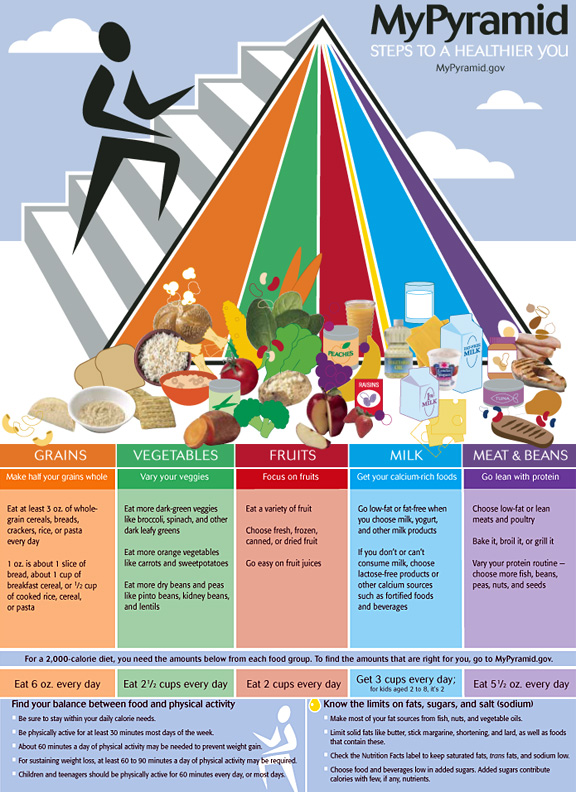
The food pyramid is a good example. When it first debuted in 1992, there was enormous pressure from food industry lobbyists - meat and dairy, mainly - over the wording and placement of the food groups. The most recent pyramid (MyPyramid) is designed poorly because of, yes, lobbyists from the same industries. Compare:


Even at a reduced scale, there are noticeable differences in clarity, effectiveness, and overall message between the two models. The latter does have certain improvements over its predecessor, namely, greater details and explanations, factors in people with lactose intolerances, and has an image stressing the importance of exercise. But the MyPyramid doesn't present some of the latest evidence and advice concerning diets and nutrition (supplements, alcohol, vegetarian diets, etc.)

This is where a dietitian (of which I will be, hopefully) should step in - and not necessarily a physician (I'll talk about this in future entries) - to provide the details and advice to the individual. I often feel as if I've been thrown into the middle of a jungle with nothing but a machete because the scientific evidence for many areas of nutrition (even RDAs [recommended daily allowances] have changed, often dramatically) can offer confounding preliminary conclusions.

Some of my goals with this blog are to share and clarify what I've learned in the classroom, find the islands of sensibility, and clear away my own fog of confusion surrounding nutrition.* There will be jargon and abbreviations, but I'll try to explain them whenever it seems necessary. Hopefully, we'll all have a stronger, more nuanced understanding of nutrition.**

*Caveat: please keep in mind that I am not qualified to offer any professional nutrition advice (yet). What I present here serves as a reference and method of understanding what I learn in my classes and of nutrition and health in general. Please consult an RD for any nutrition-related advice and guidance.

**Asian nutrition is something I'll address as well, even though it's not a part of my current training. This is an area that should be part of any future RDs' education, especially now.

Friday, November 2, 2007

"Be thin to cut cancer, study says"

Of course, that's not the only recommendation made in the report, which is linked to the article and quite hefty (400+ pages). It's a comprehensive review of the latest literature on cancer and lifestyle choices. There's supposed to be a follow-up report next year - something I look forward to reading.